
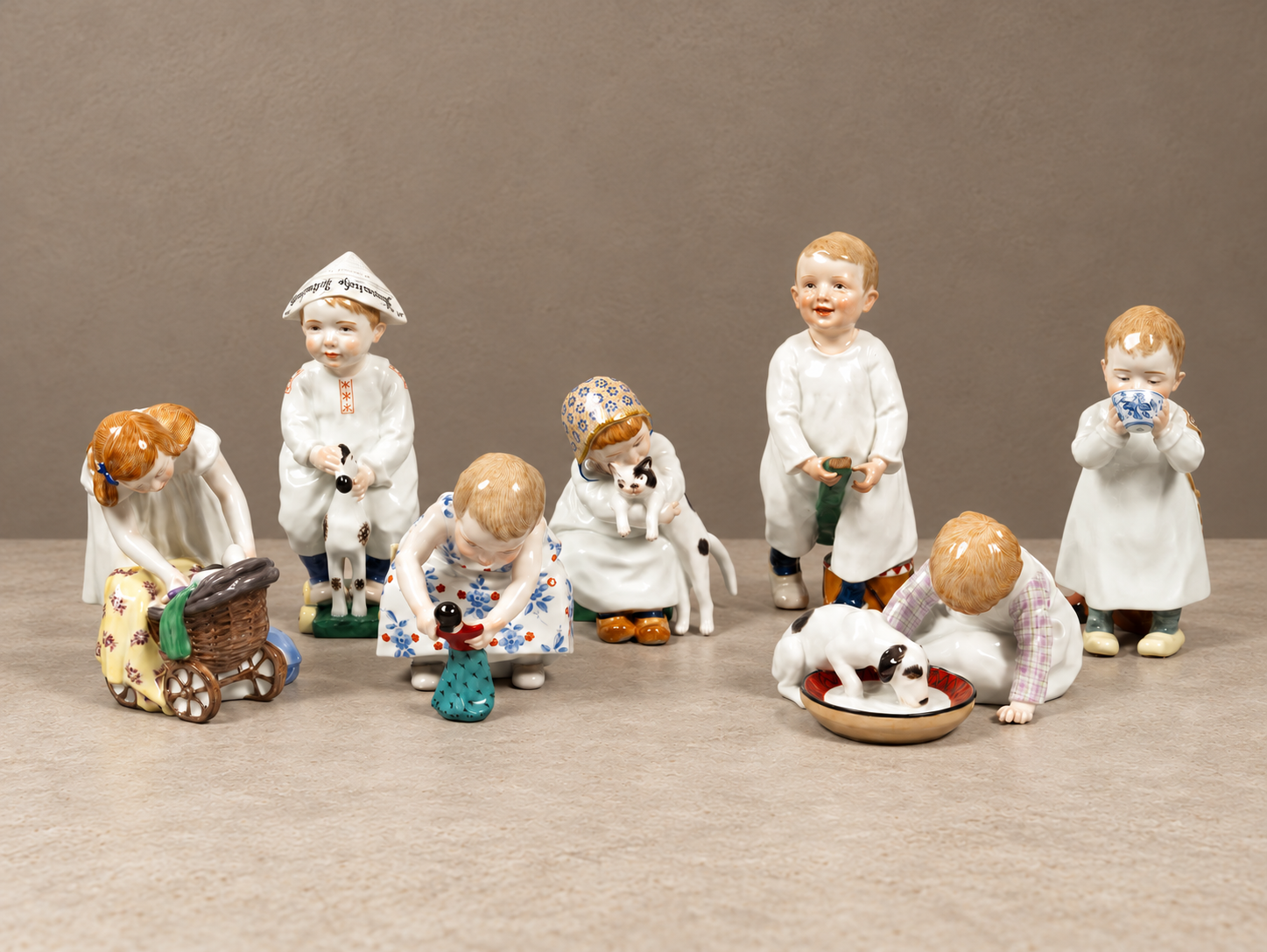
Collectors often have to decide whether to seek a companion for a single object, look for other works in the same series, or leave it on its own. Some objects were conceived as parts of an ensemble from the outset; others are brought together by the collector. Understanding this distinction is useful before deciding what to add to a collection.
Such encounters raise questions for collectors. Is it worth seeking an entire series? Do two similar vases really form a pair? What does an individual print mean if it was created as an episode in a narrative? And can a collection be coherent when its objects were never intended to stand together?
When Objects Were Conceived Together
In the history of European decorative art, objects were often designed with other pieces and their place in a room in mind. A set of vases might be intended for a chest of drawers or a mantelpiece, and two sculptures for opposite sides of an interior arrangement. Their relationship was shaped by height, silhouette, orientation and recurring decoration.
The garnitures studied by the Victoria and Albert Museum — coordinated sets of vases and other ceramic objects — remind us that the ensemble as a whole could be important. These sets became popular in seventeenth-century Europe, influencing interior decoration and ceramic production. When one piece is removed from the group, the object survives, but its intended role becomes less apparent.
It is useful for a collector today to imagine that original arrangement. Why is one vase taller? Why does another have a narrower silhouette? The answer may lie not in the unusual nature of the object itself, but in its relationship with the other pieces in the set.
Resemblance Does Not Establish a Pair
Two vases with the same decoration may look convincing together, but that alone is not enough to call them an original pair. Their dimensions, form, marks, material and workmanship should be compared. A manufactory catalogue or a document showing the model as a pair can be helpful.
The poses of some figures complement one another: their gazes or gestures are directed towards a shared centre. In other cases, a pair consists of almost identical objects. There is therefore no universal visual clue. Differences in the fineness of the painting do not, by themselves, prove that objects are unrelated — variation can be natural in hand-decorated works.
It is important to describe precisely what is known. A pair that has survived together historically, examples of the same model matched at a later date, and objects that simply work well together aesthetically are different cases. All may be interesting within a collection, but their histories are not the same.
A Series in Which Each Figure Has a Role
One of the most expressive examples of a porcelain series is the Meissen Monkey Orchestra, created by Johann Joachim Kändler in the mid-eighteenth century. Monkeys imitating human behaviour become musicians: their instruments, clothing and poses suggest a shared performance.
An individual figure invites close examination of the modelling, hand gestures, painting and comic expression. Placing several together reveals another dimension: the relationships between the characters. The conductor’s gesture takes on a different meaning when musicians stand before him.
Knowing a series does not oblige anyone to collect it in full. One collector may be interested in different versions of the same figure, another in the work of a particular modeller, and a third in music as a theme in porcelain. The same object can belong to several different collecting approaches.
A Print and Its Place in a Narrative
In printmaking, the relationship between works can be narrative as well as visual. Published in 1735, the eight engravings in William Hogarth’s A Rake’s Progress tell the story of Tom Rakewell’s decline. The complete set of eight prints held by the Te Papa museum allows the story to be followed from beginning to end.
An individual print may be interesting for its composition, characters or social satire. Yet knowing the preceding and subsequent scenes makes its events easier to understand. In this case, the series number marks a position within the narrative.
At the same time, a scene in a cycle should not be confused with a particular impression of it. For example, the Metropolitan Museum of Art describes its impression of Hogarth’s eighth scene as a reissue from 1763 in a retouched state. When collecting a cycle, it is important to know not only which scene is missing, but also the editions and states of the prints already owned.
When Is It Worth Seeking a Missing Piece?
A search is worthwhile when it is clear what a new object would contribute. A missing scene can restore the sequence of a narrative. The companion to a paired sculpture can help explain the composition of both works. A piece from a service can show how the same decoration was adapted to a different form.
Before searching, it is worth defining the desired match as precisely as possible. Does a particular model, decoration, size or period matter? Is the aim to reconstruct a historical ensemble or to assemble a personal collection? The answer determines which differences are acceptable and which would alter the intention itself.
The wish to fill an empty space can encourage hasty decisions. A missing piece should not overshadow the condition and quality of the particular example under consideration. Sometimes it makes more sense to keep searching than to add an object one would not otherwise choose.
A Collection Can Also Be United by the Collector’s Eye
Objects displayed together do not all have to belong to one series. A collection can be united by a theme, material, period or a particular artistic question. Animal sculptures by different artists allow ways of conveying movement to be compared. White porcelain figures from several manufactories reveal how light brings out modelling. Prints of the same motif offer different interpretations to explore.
No one designed such a group in advance. It gradually takes shape through a series of choices. Even so, it is useful to distinguish a personal juxtaposition from a historical relationship: objects placed together do not become an original ensemble simply because they look good beside one another.
A new work can encourage a fresh look at one already owned. Beside a restrained figure, the elaborate decoration of another becomes more apparent; next to a naturalistic animal, the precision of a stylised silhouette stands out. A collection then becomes an opportunity to compare, notice and refine one’s understanding.
Not Every Collection Needs to Be Complete
The completeness of a historical series can be established: it is possible to identify the pieces that belong to it and those that are still missing. The completeness of a personal collection depends much more on its creator’s intention. It may be small yet clearly illuminate a chosen subject.
A single object should therefore not immediately be seen as the beginning of an incomplete collection. Sometimes one figure is enough to become acquainted with an artist or a model. At other times, that very piece inspires a long search for a second.
Both choices can be well founded. What matters is understanding why an object is worth keeping and what its presence alongside others helps us see. This question is the starting point for a collection shaped by knowledge and a personal relationship with works of art.
Sources
- Victoria and Albert Museum – A history of garnitures. The history of ceramic ensembles and their place in European interiors.
- MEISSEN – Monkey Orchestra. The history and characters of the series of figures created by Kändler.
- Museum of New Zealand Te Papa Tongarewa – A rake’s progress. Plate 8. The rake in Bedlam. Hogarth’s cycle, its sequence and the 1735 edition of the engravings.
- The Metropolitan Museum of Art – A Rake’s Progress, Plate 8. The date, reissue and state of a particular impression.
The historical examples draw on the sources listed above. The reflections on building a collection and bringing objects together are RARITUS editorial interpretations.